Friday, January 27, 2012

Jason's F/V Holly Lynn

This fishing vessel, the Holly Lynn, is owned by a friend and neighbor who taught me all I know about lobster fishing and helped me buy and maintain my own boat - she's a beauty! 


Oil on 5 x 7 canvas board, $50 + $8 s/h

Lobster Boat on Mooring

For several years, I had my own 30' lobster boat and fished a handful of traps along the Downeast coast of Washington County, Maine.  While I was out and about, I took lots of photos of other lobsterboats for possible future paintings.  I've been working on two of them the last couple of days - here is the first one.


This is a 5 x 7 oil on canvasboard, $50 + $8 s/h.

Saturday, January 21, 2012

Skiff II

Here's another view of the same skiff - I love painting reflections.
Oil on canvas board, 9 x 12, $150

Thursday, January 19, 2012

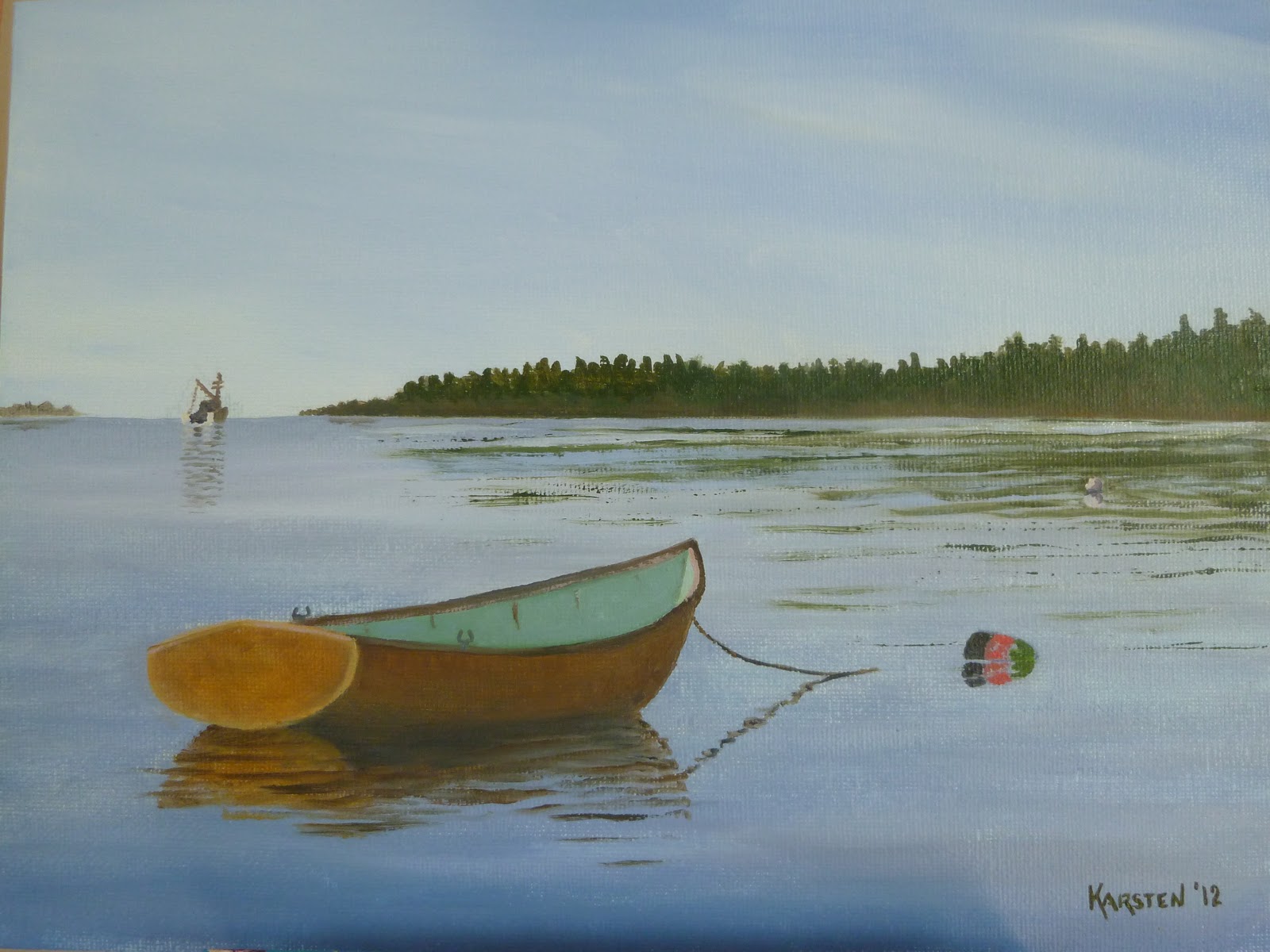
Skiff on Mooring I

Skiffs are essential for lobstermen to get to and from their lobsterboats moored in the harbor.  They are notoriously neglected, left to bang against each other at the dock when not in use, and maintained only when absolutely necessary.  Most of them are home made out of plywood and liquid fiberglass.  Yet they can be some of the most picturesque and interesting boats around.  Last summer this one caught my attention (amazingly well kept), so I took a few photograps of it and decided to paint a couple of different views of the skiff.  Here is the first one.

Oil on canvasboard, 9 x 12, $150

Monday, January 16, 2012

Painting Fog with Atmosphere


I have had several requests for an explanation of how I paint fog. Well, I don't really paint fog, as such. Maybe you could paint a scene, let it dry, and then glaze over it with a thin layer of "fog", I don't know. What I do is use my "atmosphere". Atmosphere is usually your sky color, or some other light bluish grey paint that you mix into your "local color" - the "real" color of objects viewed up close. As objects recede into the distance, you add more of the atmosphere color to it, to make the color blur, giving the illusion of distance. I do this in most of my paintings. What's different about fog paintings is that I use much more of the atmosphere mix, making even closer objects appear enveloped in fog. When painting fog like this, you can also easily control the tone or mood of the whole painting by mixing some of the same atmosphere into all of your colors, thereby giving the painting "color harmony" - an overall blue tone, an overall purple tone, etc.

Downeast Shoreline


This gravelly beach reminds me a lot of my growing-up years in my native Norway. The scene is located at South Addison Public Beach, Mooseneck, Maine. The painting is done in oil on an 11 x 14 canvasboard and priced at $200.

Thursday, January 12, 2012

"Writers Block" - tip of the day


Just like writers, artists occasionally get "writers block" - either we pull out a canvas, knowing just what to paint, then sit staring at the frightening blank canvas for hours, unable to get started, or, we stand there looking at an unfinished painting, not quite knowing how to complete it.
Solution?
In the case of the blank canvas, roughly outline your scene and get some underpaint on it - just a thin wash indicating the approximate colors (and values) of the scene - once there is something on the canvas, the process becomes so much easier.
In the case of the unfinished painting, just put it aside (but in view), and start another one. That way, your hesitation won't interfere with your productivity, and almost invariably, you'll be inspired to complete the painting before long. I sometimes have three or four paintings "in progress." (See the current four in the photo above.)
Happy painting!